Analysis of Flashing Toy Materials: Wholesale Cost Differences and Advantages of Eco-friendly PVC vs. ABS
In the global export market for children’s flashing toys, eco-friendly PVC and ABS stand as the two primary core materials, directly determining a product’s cost, quality, regulatory compliance, and ultimate competitiveness in the retail market. From an international wholesale perspective, this article analyzes the differences between these two materials—covering cost structures, performance advantages, applicable scenarios, and procurement strategies—to provide valuable decision-making insights for overseas buyers and brand owners.
I. Core Characteristics of the Two Materials (Tailored for Flashing Toy Applications)
1. Eco-friendly PVC (Adjustable Softness/Hardness; The Preferred Choice for High-Volume Mainstream Products)
Eco-friendly PVC is a thermoplastic material that, through modification and the use of phthalate-free and plasticizer-free formulations, meets international toy safety standards such as EN71, CE, CPSIA, and CPC.
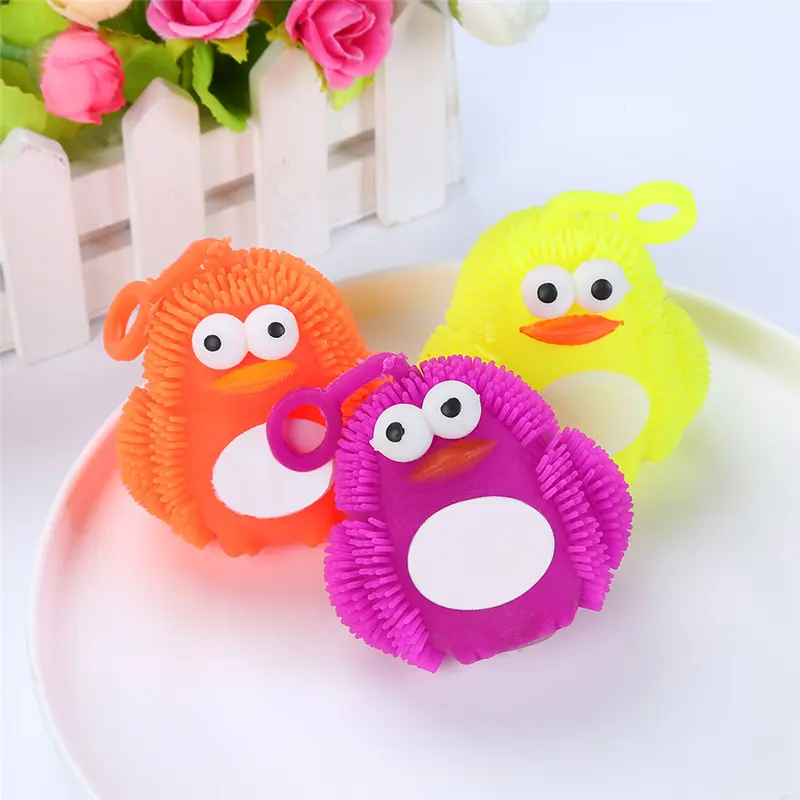
Its hardness can be flexibly adjusted, making it suitable for products such as light-up balls, flashing figurines, and soft-rubber light-up pendants.
It possesses strong colorability and uniform light transmission, effectively complementing the illumination effects of LED beads to ensure a high-quality visual appearance.
It is resistant to moisture and daily bumps, making it ideal for frequent, active play by children.
It features a high recyclability rate—with closed-loop recycling efficiency reaching up to 85%—thereby meeting overseas environmental procurement requirements.
2. ABS (Engineering Plastic; The Standard Choice for High-End, Structurally Complex Products)
ABS is a copolymer composed of acrylonitrile, butadiene, and styrene, offering a unique combination of rigidity, toughness, and dimensional stability.
It features high hardness and strong impact resistance, making it suitable for products such as flashing building blocks, light-up spinning tops, and structurally complex electric flashing toys.
It boasts a high surface finish and excellent adhesion for painting and printing, lending the product a distinct premium aesthetic.
It offers superior electrical insulation properties, making it ideal for flashing toys containing internal circuitry and LED light boards, thereby enhancing safety and stability.
Its resistance to high temperatures and deformation is superior to that of ordinary PVC; consequently, it is less prone to warping or discoloration (whitening) during long-term use.
II. Wholesale Perspective: A Comprehensive Breakdown of Cost Differentials (from an International Procurement Viewpoint)
1. Raw Material Unit Price (Based on International Commodity Benchmarks)
Eco-friendly PVC: $0.8–$1.2 per pound; price fluctuations are minimal—typically within 10%—and the supply chain is stable.
ABS: $1.5–$2.5 per pound; heavily influenced by crude oil and chemical market trends, with potential price fluctuations reaching up to 20%.
→ For an equivalent weight of raw material, the procurement cost of ABS is 40%–80% higher than that of eco-friendly PVC.
2. Production and Processing Costs
Eco-friendly PVC: Features a low injection molding temperature and excellent flowability; requires no pre-drying, resulting in energy savings, faster cycle times, and higher yield rates, leading to lower per-unit processing costs. Soft PVC variants can be integrally molded (single-piece formation), simplifying assembly and further reducing costs.
ABS: Requires drying to remove moisture; processing temperatures and equipment requirements are more demanding. Cycle times are slightly slower, resulting in processing costs that are 10%–20% higher. Complex structures often necessitate multiple processing stages, leading to accelerated mold wear and tear.
3. Batch and Logistics Costs
Eco-friendly PVC: Possesses a moderate density; for a given volume, it is lighter in weight, resulting in lower per-unit costs for sea or air freight. It is well-suited for large-volume container shipments, offers flexible minimum order quantities (MOQs), and places less pressure on inventory management.
ABS: High material strength allows for thin-walled, lightweight designs; however, the high unit price of the raw material results in higher capital tie-up for large-volume procurement. High-end products made from ABS are often produced in small, customized batches, which limits the ability to effectively amortize fixed costs.
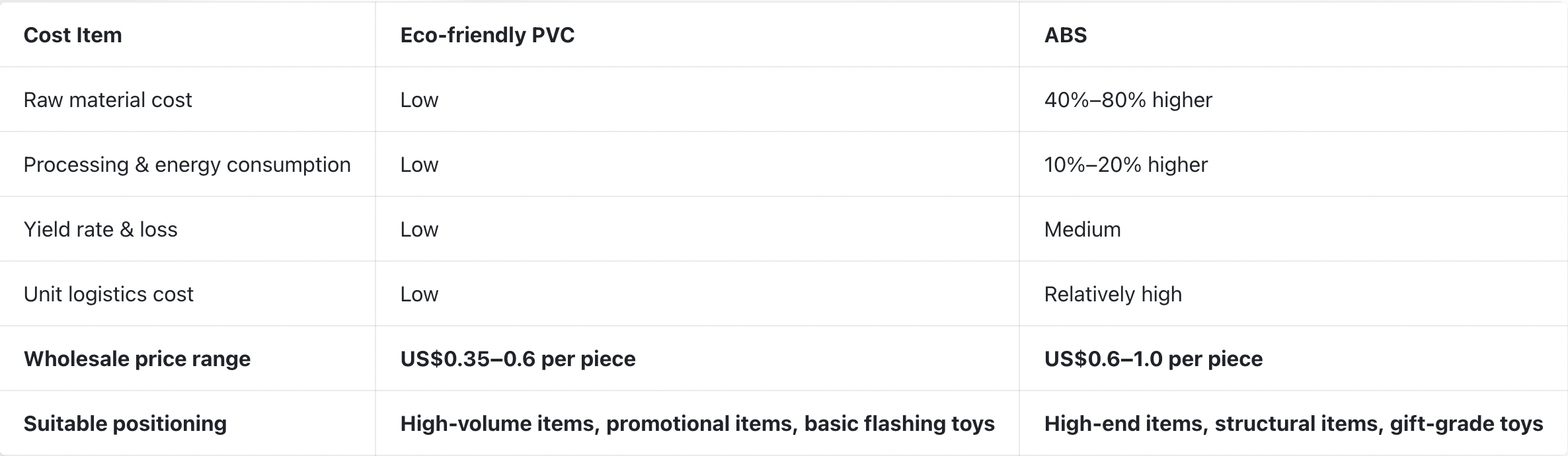
4. Comprehensive Wholesale Cost (Illustrated using a “Flashing Toy” model as an example)
III. Core Advantages: A Comparison of Two Materials
Core Advantages of Eco-friendly PVC
Exceptional Cost-Effectiveness: Low costs for both raw materials and processing, making it ideal for large-volume orders, mass-market retail, and promotional light-up toys; offers strong price competitiveness at the consumer level.
Tactile & Luminous Compatibility:** Features a soft, skin-friendly texture with uniform light transmission; the LED flashing effect is gentle and non-glaring, ensuring high acceptance among children.
Environmental & Regulatory Compliance Phthalate-free, heavy-metal-free, and recyclable; meets environmental and safety regulations in the EU and North America.
Flexible Production: Adjustable hardness and a wide range of color options; low mold development costs allow for rapid response to overseas customization requests.
Core Advantages of ABS
Structural Integrity & Durability: Highly resistant to drops and twisting, with excellent dimensional stability; suitable for complex light-up toys featuring articulated joints, interlocking parts, or motorized functions.
Premium Quality & Value: Offers a high-end surface finish and texture, making it ideal for branded corporate gifts, specialty retail counters, and mid-to-high-end distribution channels.
Electrical Safety: Possesses superior insulation properties, making it well-suited for light-up toys equipped with circuit boards and multiple LED beads, thereby minimizing the risk of short circuits.
Long-Term Value: Boasts a long product lifespan with low repair rates and minimal after-sales service costs, effectively enhancing brand reputation and encouraging repeat purchases.
IV. Exporting Light-Up Toys: How to Choose the Right Material (Overseas Sourcing Strategy)
Prioritize Eco-friendly PVC
Products: Light-up stress balls, soft-rubber glowing figurines, luminous keychains/pendants, and small party novelty toys.
Channels: Mass-market retailers (supermarkets/hypermarkets), high-volume cross-border e-commerce platforms, promotional gift campaigns, and night markets/budget-friendly retail outlets.
Objectives:Cost control, securing large-volume orders, rapid market penetration, and capturing the mass consumer market.
Prioritize ABS
Products: Light-up building blocks, motorized light-up toys, high-precision glowing models, and premium gift-boxed toy sets.
Channels:Brand-specific retail counters, specialty boutiques (e.g., maternal/child stores), toy retail chains, and high-end corporate gift orders.
Objectives: Delivering superior quality, building brand equity, supporting premium pricing strategies, and maximizing profit margins per unit.
V. Export Compliance and Sourcing Recommendations
Environmental Standards Are the Baseline: Whether using PVC or ABS, comprehensive test reports—such as EN71, CE, CPSIA, and CPC—must be provided to mitigate customs clearance risks.
Specify Material Formulations: For PVC, select eco-friendly variants that are free of phthalates and heavy metals; for ABS, insist on virgin material and reject recycled plastics, which can compromise structural strength and safety.
Structure Dictates Material Choice: Soft-touch components or large luminous surfaces call for PVC; complex structures, load-bearing parts, or motorized mechanisms require ABS.
Strategic Cost Optimization: Utilize PVC for the main body of the product while reserving ABS for load-bearing structural components, thereby balancing both cost-efficiency and product quality.
Key Points for Factory Audits: Verify raw material traceability, environmental impact assessments for production, and quality control protocols to ensure compliance with social responsibility standards such as BSCI.
VI. Conclusion
Eco-friendly PVC: Characterized by low cost, ease of production, a pleasant tactile feel, and excellent luminous effects, it serves as the primary material for mass-market light-up toys destined for export—ideal for high-volume production and value-oriented strategies.
ABS: Distinguished by high structural strength, superior surface finish, and robust stability, it is the standard choice for premium, structurally complex designs—supporting higher price points and brand-building initiatives.
For overseas buyers, there is no single “absolutely superior” material; rather, there is only the solution that best fits the specific context. By centering decisions on product positioning, distribution channels, and budget constraints—and strategically combining the use of both materials—buyers can strike the optimal balance between cost, quality, and regulatory compliance, thereby securing a stable and competitive foothold in the global market for children’s light-up toys.
Post time: Mar-27-2026