2026 Comprehensive Guide to Importing Children’s Stress-Relief Toys: Compliance Requirements and Practical Tips
Children’s stress-relief toys, with their fun, interactive, and emotionally soothing characteristics, have become a popular category in the global mother and baby products and leisure market. In 2026, regulations for toy imports in various countries underwent a concentrated upgrade, with stricter requirements imposed on everything from chemical controls and safety certifications to traceability systems. For importers of stress-relief toys, accurately grasping the compliance standards of various regions, perfecting customs clearance procedures, and controlling product quality are the core keys to successfully entering target markets. This article will focus on the new import regulations in major global markets in 2026, outlining the core considerations for importing children’s stress-relief toys, covering all dimensions including regulatory requirements, certification standards, customs clearance practices, and quality control, providing practical guidance for import trade.
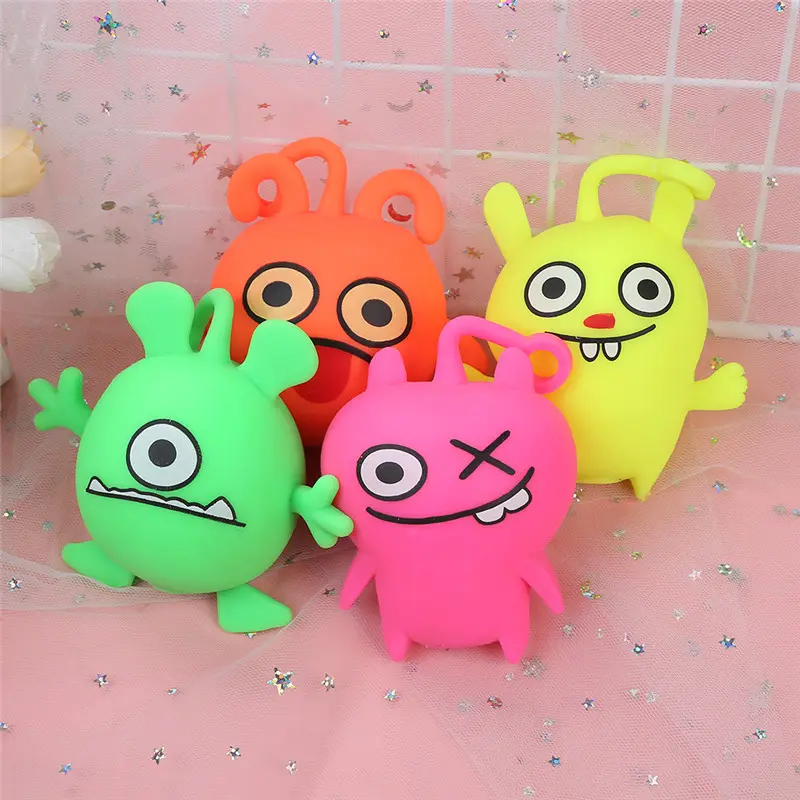
I. Regulatory Upgrades in Core Markets: Chemical and Safety Controls Become Paramount
The core changes in global toy import regulations in 2026 focus on three main dimensions: restrictions on chemical substances, tightening of heavy metal limits, and detailed mechanical and physical safety regulations. The EU and the US, as major consumer markets for stress-relief toys, saw the most significant changes in regulations, becoming the core focus of import compliance.
EU: New TSR Regulations Take Effect, Upgrading Digital Traceability and Chemical Control
On January 1, 2026, the EU Toy Safety Regulation (EU) 2025/2509 (TSR) officially came into effect, replacing the previous Directive 2009/48/EC. This new regulation imposes comprehensive new requirements on plastic and stuffed toys, such as decompression toys. (Guangdong Branch of the General Administration of Customs) Stricter Chemical Bans: The intentional use of perfluorinated and polyfluoroalkyl substances (PFAS) and 10 bisphenol A substances is completely banned. New prohibited categories include endocrine disruptors, Class 1 respiratory sensitizers, and Class 1A skin sensitizers. Migration limits for heavy metals such as arsenic, cadmium, and lead have been reduced to half of their scientifically safe values: lead is limited to 2.0 mg/kg, cadmium to 1.3 mg/kg, and the migration limit for bisphenol A (BPA) has been reduced from 0.04 mg/L to 0.005 mg/L. Commonly used fillers in decompression toys, such as PVA, pectin, and starch, must pass tests for non-allergenicity and non-harmful leaching, according to the Shandong Provincial Department of Commerce.
Detailed Mechanical and Physical Safety Measures: Addressing the risks associated with expansion materials and small parts in decompression toys, expansion materials are required to pass a 20mm diameter template test to prevent accidental ingestion and intestinal obstruction by children. Decompression toys shaped like food are explicitly included in the regulations, and the risk of choking from small parts is strictly prohibited.
Digital Product Passports (DPP) Become Mandatory: Replacing traditional paper declarations, all decompression toys must be equipped with a unique digital identifier (such as a QR code). Consumers can easily access information such as the CE mark, safety warnings, batch information, and material composition. Importers must ensure that the DPP link is included in advance in online displays; violations will be considered “illegal content” by the Guangdong Branch of the General Administration of Customs.
EN71 Standard Updated: From July 31, 2026, EN 71-1:2026 will become the EU harmonized standard, introducing new requirements for tensile and abuse tests on decompression toys. For example, inflatable decompression toys must complete small parts testing in both inflated and deflated states, and wooden parts must undergo immersion bonding testing.
USA: CPC Certification Mechanism Upgraded, Traceability and Testing Requirements Stricter: As a core market for children’s decompression toys, the US will significantly adjust the CPC (Children’s Product Certificate) certification mechanism in 2026. Dual supervision by customs and e-commerce platforms will significantly raise the compliance threshold.
Mandatory Updates to Testing Standards: Decompression toys must comply with the latest version of ASTM F963-23, with a focus on strengthening small parts detachment testing (must withstand a 90N pull without detachment) and sharp edge testing. Plush/textile decompression toys must also pass the 16 CFR Part 1610 flammability test, with burning speed meeting the limits.
Direct Transmission from TIC Agencies Becomes the Only Channel: Amazon, TEMU, and other platforms have closed the channels for sellers to upload their own testing reports. Verification results must be directly synchronized to the platform by CPSC-accredited TIC (Testing, Inspection, Certification) agencies. Falsified test reports and unqualified laboratories will directly result in container seizure and store freeze.
Strengthened Chemical Safety Testing: Total lead content control has been upgraded, with lead content in contact coatings ≤90ppm and in substrates ≤100ppm. Phthalate testing has been upgraded from the traditional 6P to 8P, adding DIBP, DPENP, and other testing items. The plastic shell and soft filling parts of decompression toys must be fully covered by testing.
Refined Traceability Labeling: Decompression toys must have permanent traceability labels affixed to them, specifying the city of manufacture (simply labeling “China” is considered a violation), manufacturer’s name, production date (accurate to year, month, day/week), and batch number. There are also mandatory requirements for the font of warning messages on the packaging: “WARNING” and similar terms must be at least 3.2mm high, and hazard descriptions must be at least 1.6mm high.
Other Major Markets: Regional Compliance Requirements Vary
Canada: Decompression toys for children under 3 years old must be SOR certified, focusing on testing for physical safety risks such as small parts falling off and sharp points. Product labels must be bilingual (English and French) and include the “Canada Hazardous Product Act” compliance mark.
Australia and New Zealand: Decompression toys for children aged 0-14 years old must comply with AS/NZS ISO 8124 certification, covering comprehensive testing of mechanical and physical properties, flammability, and chemical toxicity. Certification is valid for 5 years and requires timely review after regulatory updates. Labels must clearly indicate the compliance standard number.
South Korea: Imported stress-relief toys require material composition reports and safety test certificates. Wooden packaging must be accompanied by IPPC fumigation certificates (stamped with the ISPM15 mark). Stress-relief toys involving brands/IP must provide intellectual property authorization documents; otherwise, customs will directly detain them.
II. Import Core Certifications: Matching to Required Requirements, Avoiding the Misconception of “One Certificate for All”
Children’s stress-relief toys fall under the category of children’s products. Each market has its own mandatory certification requirements, and certification standards are not interchangeable. Importers must complete certification registration in advance according to the target market. The core certification list is as follows:
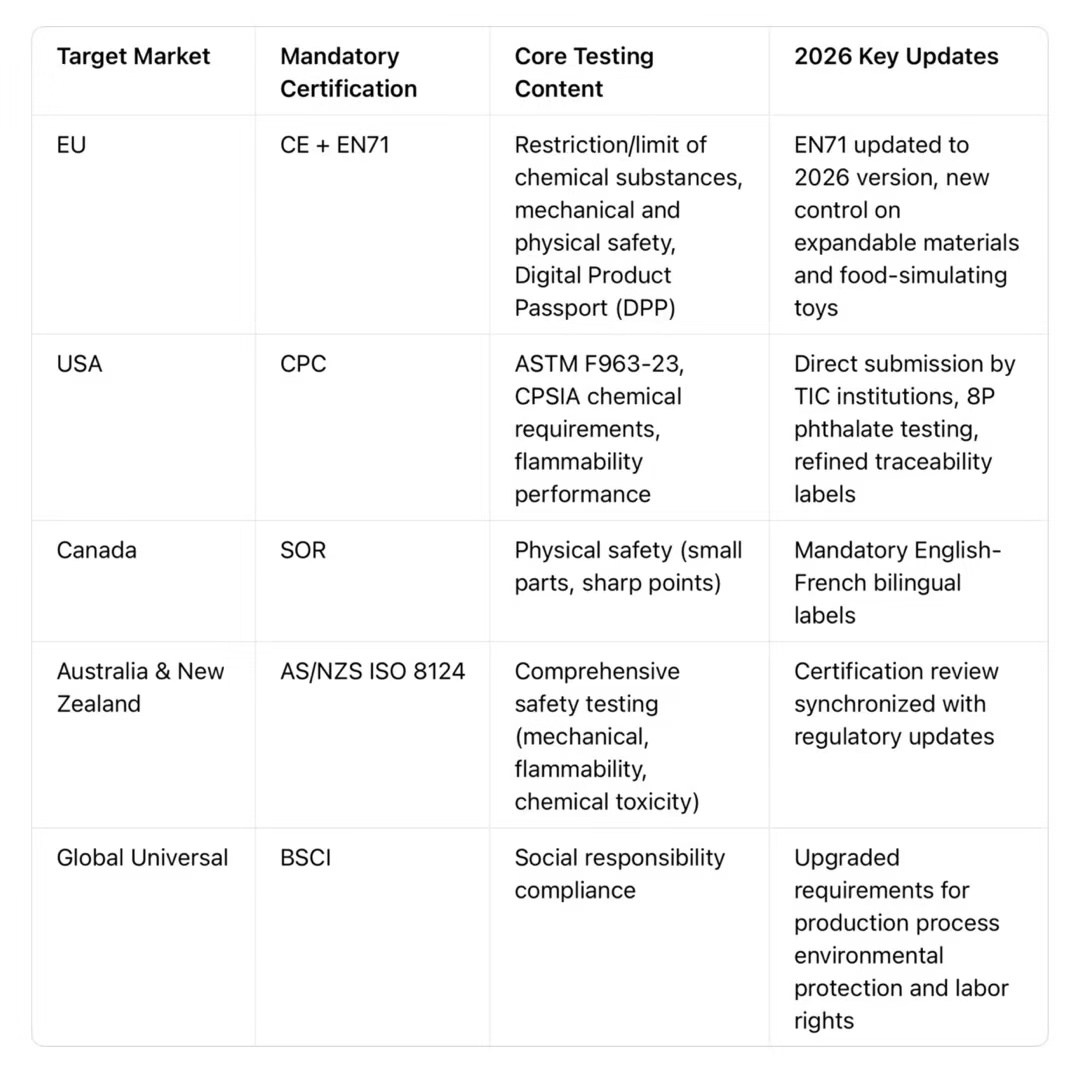
Key points for certification practice:
* **Choose a qualified testing organization:** For example, in the US, choose a CPSC-accredited laboratory; in the EU, choose a notified body. Avoid certification invalidation due to an unqualified laboratory.
* **Certificate and product matching:** Different types of decompression toys (e.g., PVA-filled, LED-lit, inflatable toys) require separate certifications; test reports cannot be mixed.
* **Advance registration:** EU DPP digital passports must be registered in the system before importation. US CPC certificates must include complete information such as product model, test date, and laboratory information.
III. Customs Clearance Practice: Document Preparation and Process Control to Avoid Customs Delays
In 2026, customs authorities in various countries significantly increased their scrutiny and inspection of imported children’s toys. Decompression toys, due to their multi-material fillings (such as PVA, beads, starch, etc.), require well-prepared declaration documents in advance to ensure consistency. The core customs clearance requirements are as follows: Basic declaration documents are indispensable. All market imports require a commercial invoice, packing list, bill of lading/air waybill, and purchase contract. The invoice must specify the exact name, quantity, unit price, and country of origin of the decompression toy. Avoid vague descriptions such as “decompression toy”; specify details such as “PVA-filled animal-shaped decompression ball” or “geometric silicone decompression toy.”
Special documents to be prepared as needed:
Certificate of Origin: ASEAN and RCEP member countries can enjoy agreed tariffs upon presentation of this certificate; this must be obtained from the supplier in advance.
Material and Safety Certificates: Provide component testing reports and safety certificates for filling materials (e.g., no harmful leaching test for PVA and pectin).
Intellectual Property Documents: For decompression toys involving cartoon characters or brand logos, authorization letters from the copyright holder/brand owner are required to avoid infringement and seizure.
Fumigation Certificate: If wooden pallets/crates are used for packaging, an IPPC fumigation certificate is required, and the packaging must bear the ISPM15 mark.
Key Considerations for Declaration and Inspection:
Accurate HS Code Classification: Decompression toys must be classified according to their material. For example, plastic toys should be classified under HS code 39264000, and stuffed toys under HS code 95030029. Incorrect coding will lead to incorrect tax rates and inspection delays.
Accurate Price Declaration: Avoid underreporting value. If the declared price is significantly lower than the market price, customs will initiate a valuation process, requiring the provision of purchase contracts, payment vouchers, and other pricing evidence.
Cooperation with Sampling and Testing: High-risk decompression toys (such as those containing small parts or light-up components) may be sampled and tested by customs. Importers must allow sufficient time for testing in advance to avoid additional costs due to port congestion.
Consistent Documentation: The product name, quantity, weight, and material in the customs declaration, invoice, and packing list must be completely consistent. Inconsistent data will directly lead to order rejection.
IV. Product Quality Control: Mitigating Import Risks at the Source
The quality of decompression toys is a core risk for importers. With increased regulations in various countries in 2026 requiring traceability throughout the entire product manufacturing process, importers need to strengthen quality control across three dimensions: supplier selection, raw material testing, and production process control.
Selecting Compliant Suppliers: Prioritize manufacturers with international certifications such as EN71, CPSIA, and BSCI, and require suppliers to provide production process traceability documents to ensure the source of raw materials and production batches are traceable;
Comprehensive Raw Material Testing: Conduct comprehensive testing on core materials of decompression toys (such as…) (PVA, silicone, starch, beads, etc.) Third-party laboratories are commissioned in advance to test for harmful chemicals, heavy metal leaching, and allergenicity to avoid the entire batch of goods being scrapped due to substandard raw materials; Production process sampling inspection: Sampling inspections are conducted on key production stages (such as filling, bonding, and molding), focusing on the firmness of small parts, edge smoothness, and the sealing of filling materials to prevent safety hazards such as detachment and leakage; Environmentally friendly material compliance: Countries around the world are strengthening environmental requirements for toys. Biodegradable and odorless environmentally friendly materials are prioritized, avoiding the use of recycled materials, inferior adhesives, and other materials that do not meet environmental standards, ensuring that the production process complies with green manufacturing requirements.
V. Import Risk Control: Common Misconceptions and Countermeasures
In 2026, the compliance threshold for toy imports increased. Importers are prone to falling into compliance misconceptions due to unfamiliarity with the new regulations. Avoiding the following core risks in advance can significantly reduce trade losses:
Certification Misconception: Do not assume that “one certificate is valid worldwide.” Certifications must be obtained separately for each target market. For example, EU CE certification cannot replace US CPC certification.
Labeling Misconception: Ignoring the detailed requirements for traceability labels and warning statements. For example, failure to indicate the city of production in the US or the absence of a DPP QR code in the EU will lead to compliance failure.
Testing Misconception: Using outdated testing standards (such as US ASTM F963-17) or failing to perform phthalate 8P testing. Testing, or choosing an unqualified laboratory, will render the report invalid.
Intellectual Property Misconceptions: Unauthorized use of cartoon or anime character designs in decompression toys is easily deemed infringement by customs, leading to penalties such as confiscation and fines.
Logistics Misconceptions: Failure to fumigate wooden packaging or mixing different types of toys can easily cause inspection delays. It is recommended to declare high-risk decompression toys separately to reduce the probability of inspection.
Risk Response Strategies: Conduct a comprehensive compliance assessment before importing, and entrust a professional toy import compliance agency to review the compliance of products, certifications, and documents; sign compliance agreements with suppliers, clarifying that the supplier will bear the responsibility for any detention or fines caused by product non-compliance; establish a product traceability system to ensure that the raw materials, production, and testing information of each batch of goods are traceable.
Post time: Mar-06-2026